2023 · Conference Activation
ABB YuMi Coffee Robot
A cobot serving coffee at industry conferences. Built at Sheridan's CAMDT lab as a moving demo of our automation capabilities, the booth turned passersby into conversations and conversations into projects.
50%
Increase in booth engagement
3 mo
Design, build, and deploy
1
ABB YuMi cobot, two arms
↑
Project conversations after the show
The Situation
A conference booth is a hard place to start a conversation.
CAMDT's pitch was real automation work for industry. The problem was demonstrating it in a hallway. Posters and laptops did not differentiate the booth from the twenty others around it.
We needed something that would make people stop, watch, and stay long enough for a conversation. The brainstorm landed on the simplest possible hook: have the robot make you a coffee.
The hook was the easy part. The real decision was that every subsystem in the build had to put a different CAMDT capability on display. Custom fixtures for rapid prototyping and 3D printing. A custom cup dispenser for electronics prototyping and mechatronic design. Ignition on a tablet for industrial automation. The cobot to pull it all together. By the time a visitor finished their espresso, they had watched the lab demonstrate four separate disciplines without us having to say a word.
01 · The Build
It started with the cobot on a bench in the lab.
The platform was an ABB YuMi: a dual-arm collaborative robot designed to work safely alongside people. That was the whole point. A robot we could put on a conference floor with cups and capsules and members of the public walking up to it without fencing or a safety cage.
Around the YuMi we built a set of custom fixtures: capsule holders, alignment jigs, the cup tower, the drip tray. All of it was 3D printed in the lab and iterated through several revisions in a single week. This was the part of the build that put our rapid prototyping and additive manufacturing capability on display, and the fact that we could re-spin a fixture overnight if the arm geometry needed it.
The student team led the programming and integration. My job was to scope the demo, set the deadline, and make sure the build moved forward against the conference date. Three months from idea to a working serve.
02 · The Auxiliary Build
The robot was the easy part. The cup dispenser was the engineering.
A YuMi cannot pull a single cup off a stack. The geometry fights it. So the team designed a custom dispenser from scratch: a stepper-driven separator, a microcontroller running the drop sequence, a small custom control board wiring it back to the cell, and a 3D printed sleeve aligning the cup to where the arm could reliably pick. One cup, on cue, every cycle.
The dispenser was the chapter of the build that showed off our electronics prototyping and mechatronic design. Power, control, motion, and mechanics co-engineered in a single small subsystem, the kind of work CAMDT does on real client cells. It was also the subsystem that decides whether the demo works. A jammed cup at a conference is the whole story. We built the dispenser to be the thing that never failed.
03 · The Interface
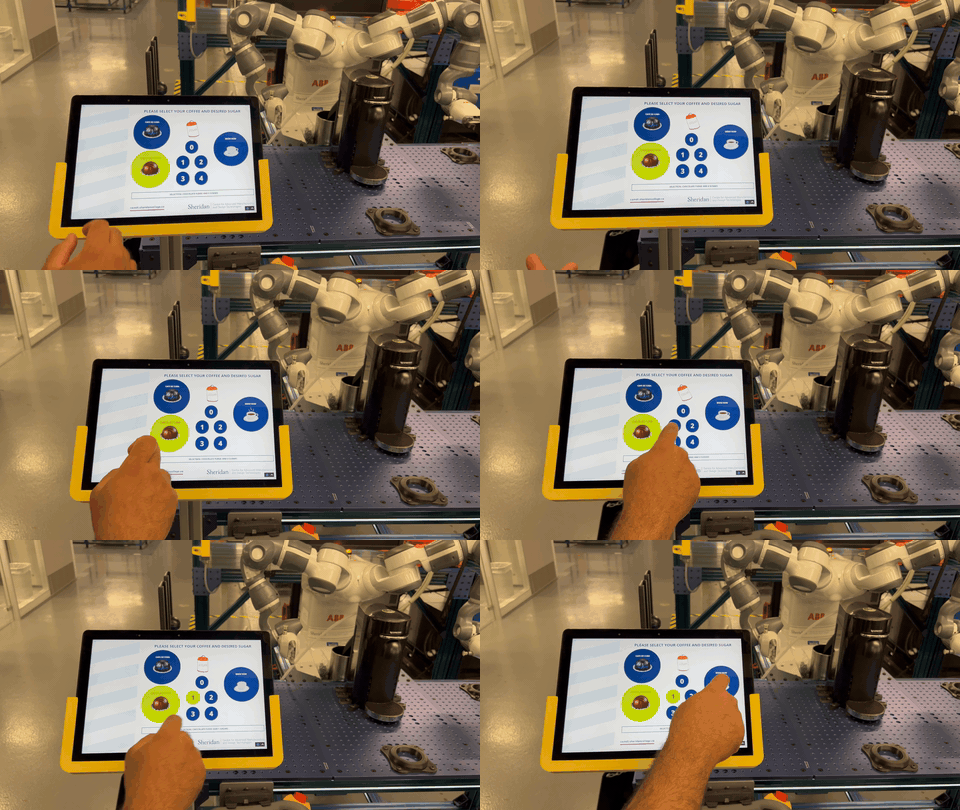
Ignition on a tablet. Pick a pod. Watch it pour.
We deployed Inductive Automation's Ignition as the HMI on a tablet next to the cell. Behind the touch screen sat the real automation work: tag configuration, OPC UA bridging to the YuMi controller, sequence logic, and fault handling. The interface itself was deliberately stripped down to a row of coffee pod options, a confirm button, and a status indicator.
This was the chapter of the build that put our industrial automation capability on display. The same stack we deploy on real production cells, wired up to drive a coffee order. The point was not to show off the screen. The point was to give visitors something they could touch on their own and then watch a real industrial software stack drive a real robot through a real cycle. Conference attendees walked away having actually used an HMI, not just looked at one.
04 · At the Show
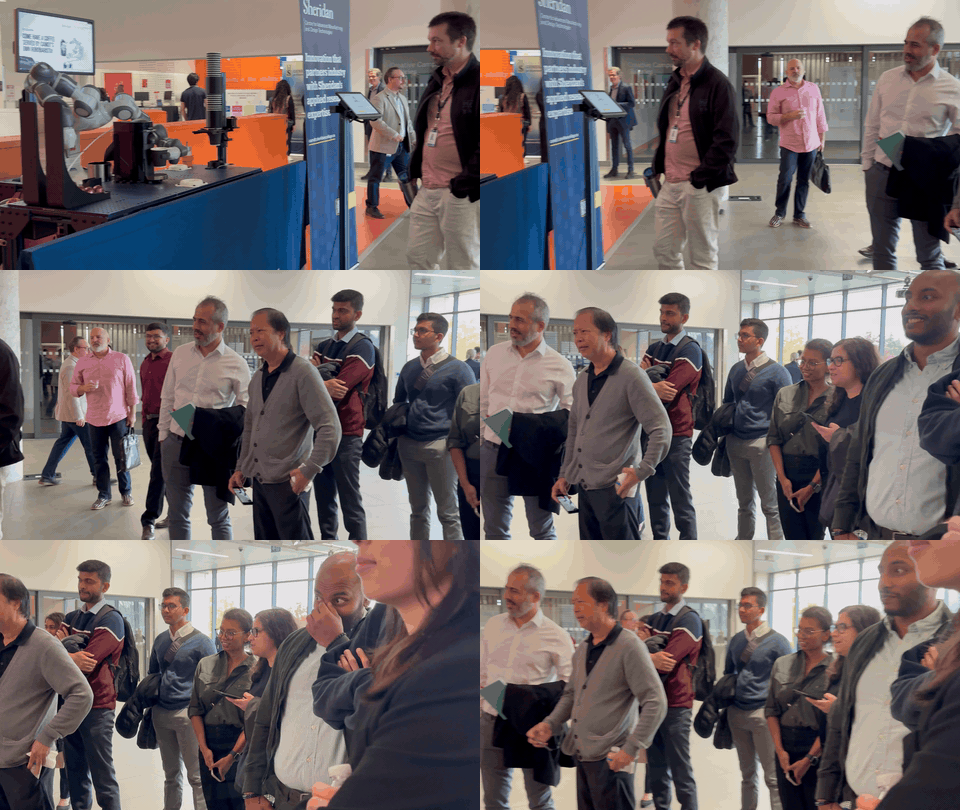
The booth pulled a crowd before the coffee was ready.
Once we set up at the conference, the demo did exactly what we hoped it would. People stopped walking. They watched a cycle. They asked who built it, what software was running, whether it could do other things. Engagement at the booth was up roughly 50 percent over the prior year.
More importantly, the conversations were different. Visitors arrived already curious, already with a question. The robot did the cold-open so the team could spend the time talking about what CAMDT could actually build for them.
05 · Full Demo
Watch the full cycle end to end.
A complete walkthrough of the cell from selection to served cup. The 3D printed fixtures, the custom cup dispenser, the Ignition HMI, and the YuMi cobot all working in sequence.
What it was really about
Marketing as engineering.
The coffee robot was not a research project. It was a marketing artifact built with research-grade tools (a cobot, an industrial HMI, custom mechanical integration) pointed at a single operational outcome: get more of the right people into a conversation with the lab.
That framing decided everything about how it was built. The dispenser had to be reliable, not clever. The HMI had to be touchable, not technical. The cycle had to be fast enough that people would still be standing there when it finished. Every decision had a business reason behind it.
Team & Credits
Mohamed Kasim
Research Assistant
Cup dispenser design and control system.
Stavro Gentille
Research Assistant
Programming and Ignition.
Darius Innus
Research Assistant
CAD design of the gripper and cell components.
Theodor Nguyen
Research Assistant
Physical assembly and cell operation.
Want to work together?
I am open to discussing new projects and creative collaborations.