2026 · XR Training Hardware
AR Fire Extinguisher Training Props
Production-ready training props for Catapult Tactical XR, a company that runs AR firefighter training. Catapult had already prototyped an instrumented extinguisher, so our job was to standardize that design to fit multiple fire extinguisher models and deliver production-ready drawings and prototypes, keeping the original trigger and pin intact so the props felt like the real thing in a trainee's hands.
 Industry PartnerCatapult Tactical XR↗
2
Person student team led
1:1
Real trigger and pin retained
AR
Sensors fitted to live extinguishers
3D
Printed mounts and nozzles
The Situation
Training feels real only when the tool in your hands does.
Catapult Tactical XR builds augmented reality training for firefighters. A trainee wears a headset, sees a live fire in a real room, and fights it with a real extinguisher in their hands.
For that to land, the extinguisher has to behave like the real thing. It needs to weigh right, pull the pin, and squeeze the trigger, while the system tracks exactly where it is pointed and when it fires. Catapult had already built a working prototype that proved this out on a single extinguisher.
The work they brought to Conestoga's SMART Centre was to standardize that prototype so the same instrumentation could fit multiple fire extinguisher models, then turn it into production-ready drawings and prototypes. I led the project as the main liaison with Catapult and the project manager for a two-person student team.
01 · The Brief
Standardize the prototype, not reinvent it.
Catapult's prototype worked, but only on one specific extinguisher. Our brief was to make it repeatable, so the same mounts and sensor placement could fit a range of extinguisher models without a redesign each time. That constraint set the direction for everything after it.
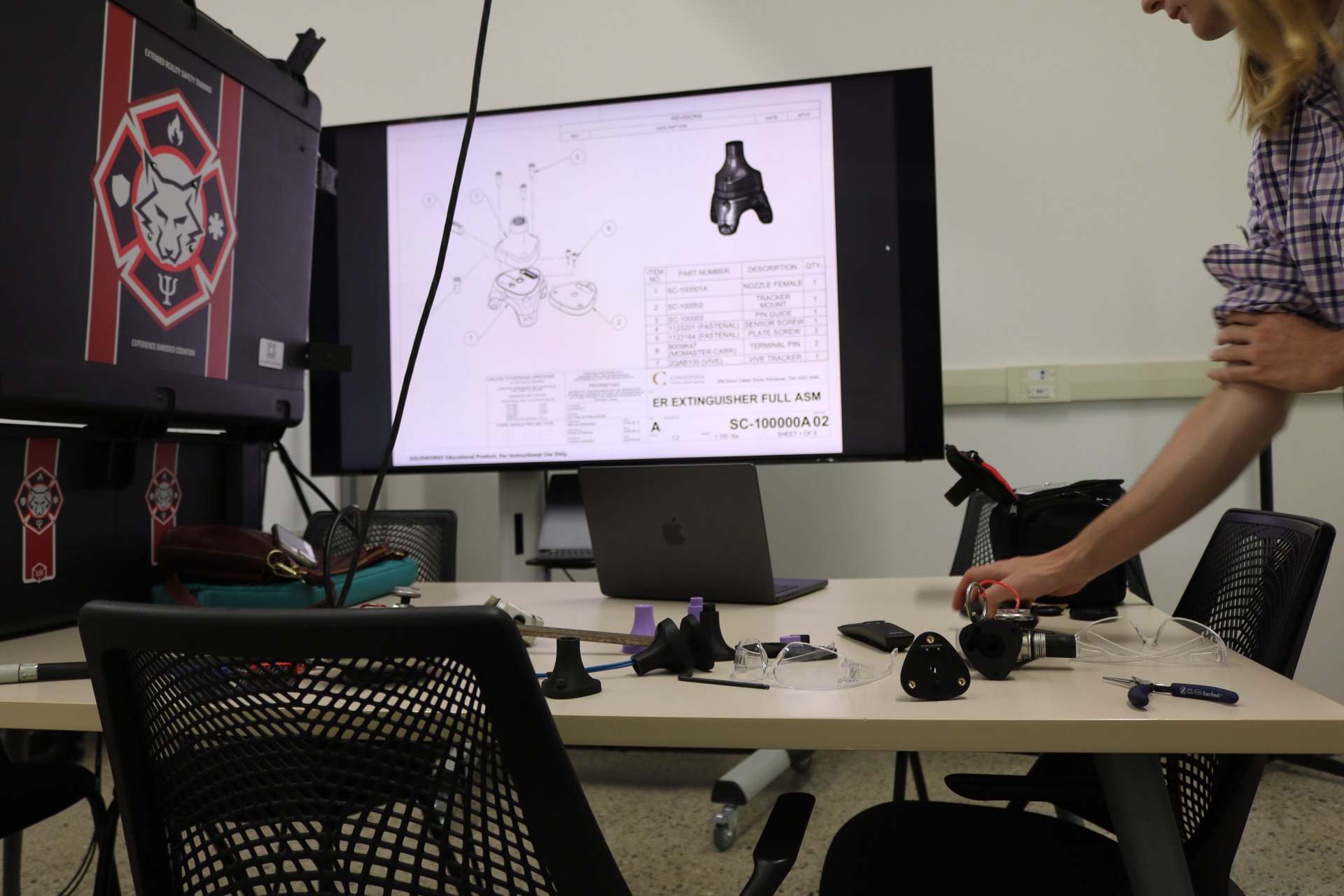
We rebuilt the full assembly in CAD, mapping where the sensors and mounts sat across the different extinguisher bodies, nozzles, and handles we had to support. Working from a shared model kept Catapult, the students, and the print queue aligned on one source of truth as the design converged on a standard, production-ready set of parts.
02 · Keeping the Trigger
Add the sensors, keep the mechanics.
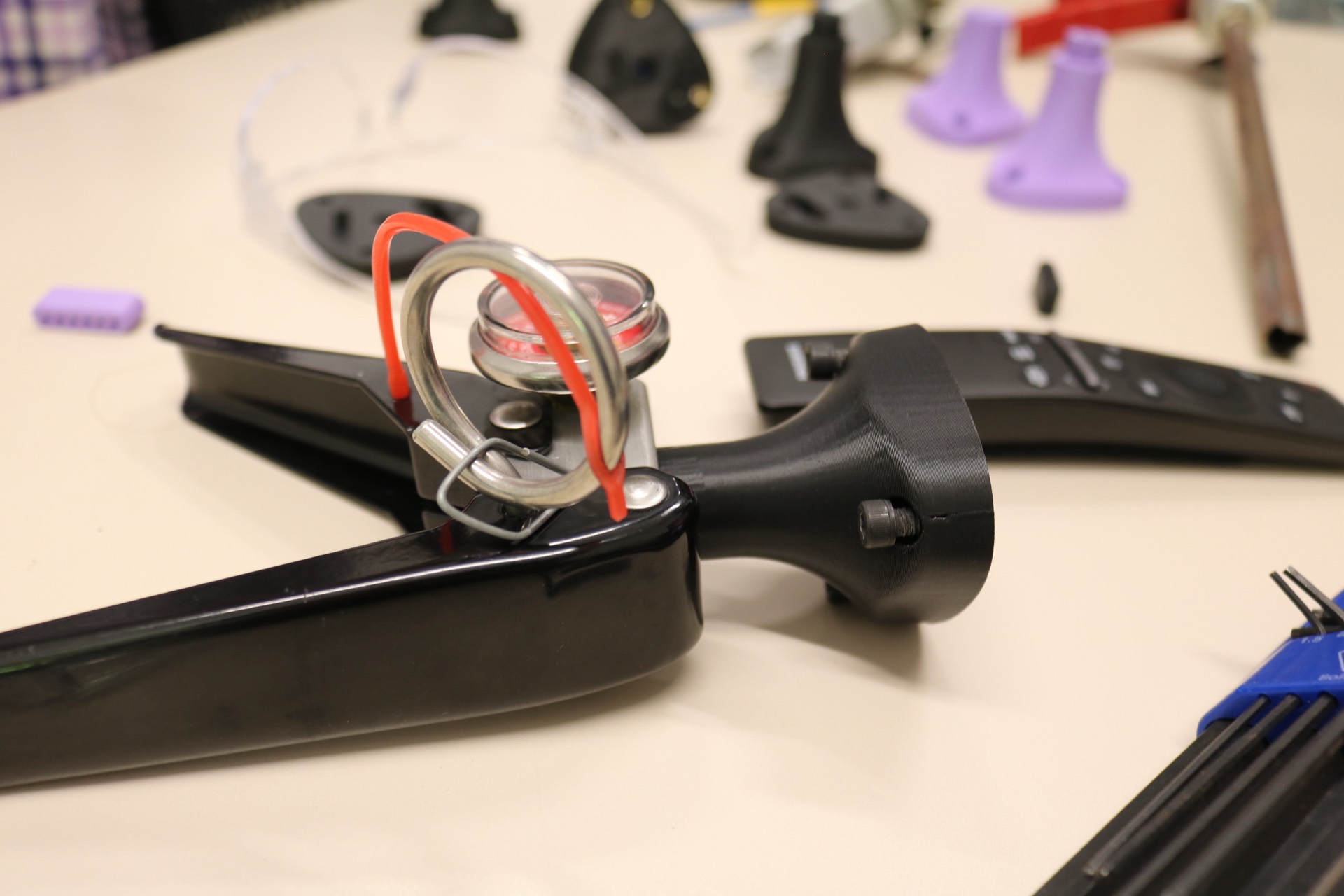
The constraint that carried across every model was simple to say and fiddly to do. Fit the AR tracking sensors and wiring onto a working extinguisher while leaving the original trigger and safety pin fully functional. A trainee should pull the pin and squeeze the handle exactly as they would on a live unit, and the system should register that action at the same moment.
Printed mounts positioned the sensors on the body and nozzle, and the wiring was routed to stay clear of the grip. Because the mechanics were untouched, the prop kept the resistance and travel of a real trigger, which is the detail that sells the whole experience in the headset.
03 · Printing the Props
Printed in carbon fiber for strength.
The mounts and nozzles were 3D printed in carbon fiber reinforced filament, chosen so the parts could take the handling and impact of live training without flexing or cracking around the sensors.
We compared the cost of machining the parts against printing them. Machining only pays off at higher volumes, so until Catapult reaches the unit numbers where that tooling makes sense, 3D printing is the cheaper and faster route and the one to keep going with.
Because Catapult travels to run the training, we advised bringing a 3D printer along so a part that breaks on site can be reprinted on the spot rather than waiting for a replacement to be produced and shipped.
04 · Testing with Catapult
Putting the props to the test.
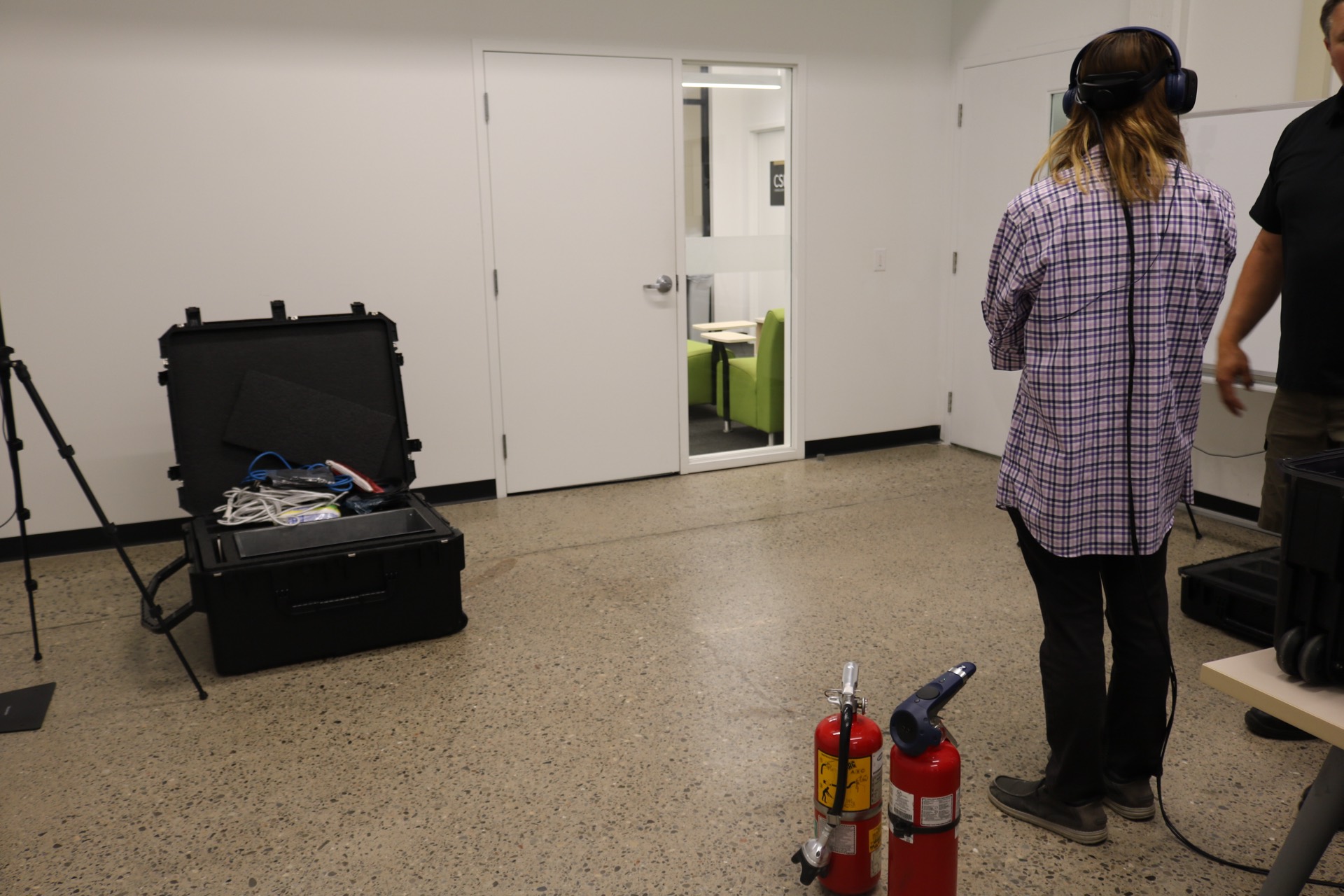
We tested the finished props with Catapult, working the instrumented extinguisher against an AR fire in the headset. The pin pulls, the trigger squeezes, and the system tracks the aim, confirming the standardized design held up the same way across the extinguishers it was built to fit.
What it was really about
The value was in making it repeatable.
A working prototype proves an idea. Turning it into something that can be built again and again, on more than one extinguisher, is a different kind of problem. That is where this project lived, in the standardization and the production-ready detail rather than the first proof of concept.
As project lead and main liaison with Catapult, my job was to hold scope, schedule, and handoff together. The two-person student team did the CAD, the printing, and the sensor integration. What they delivered was a standardized design, production-ready drawings, and prototypes that went straight to Catapult.
Team & Credits
Bryan Szegner
Research Assistant
CAD modelling, 3D printing, and assembly.
Roan Stinson
Research Assistant
CAD modelling, 3D printing, and assembly.
Want to work together?
I am open to discussing new projects and creative collaborations.